The bright stuff: Power Gems interviews Ryan Smith of K5600
 Power Gems asks Ryan Smith of K5600 Lighting to consider a time when LED lighting fixtures will be more powerful than the sun and yet are not the size of a jet engine.
HMI Lighting specialists K5600 Lighting are old pals and long-standing partners of Power Gems. Power Gems designs and manufacturers all K5600’s 1,000Hz high speed HMI ballasts and designs and supplies LED drivers/Splitter boxes and 300W single output ballast and 1200W multi-output ballasts.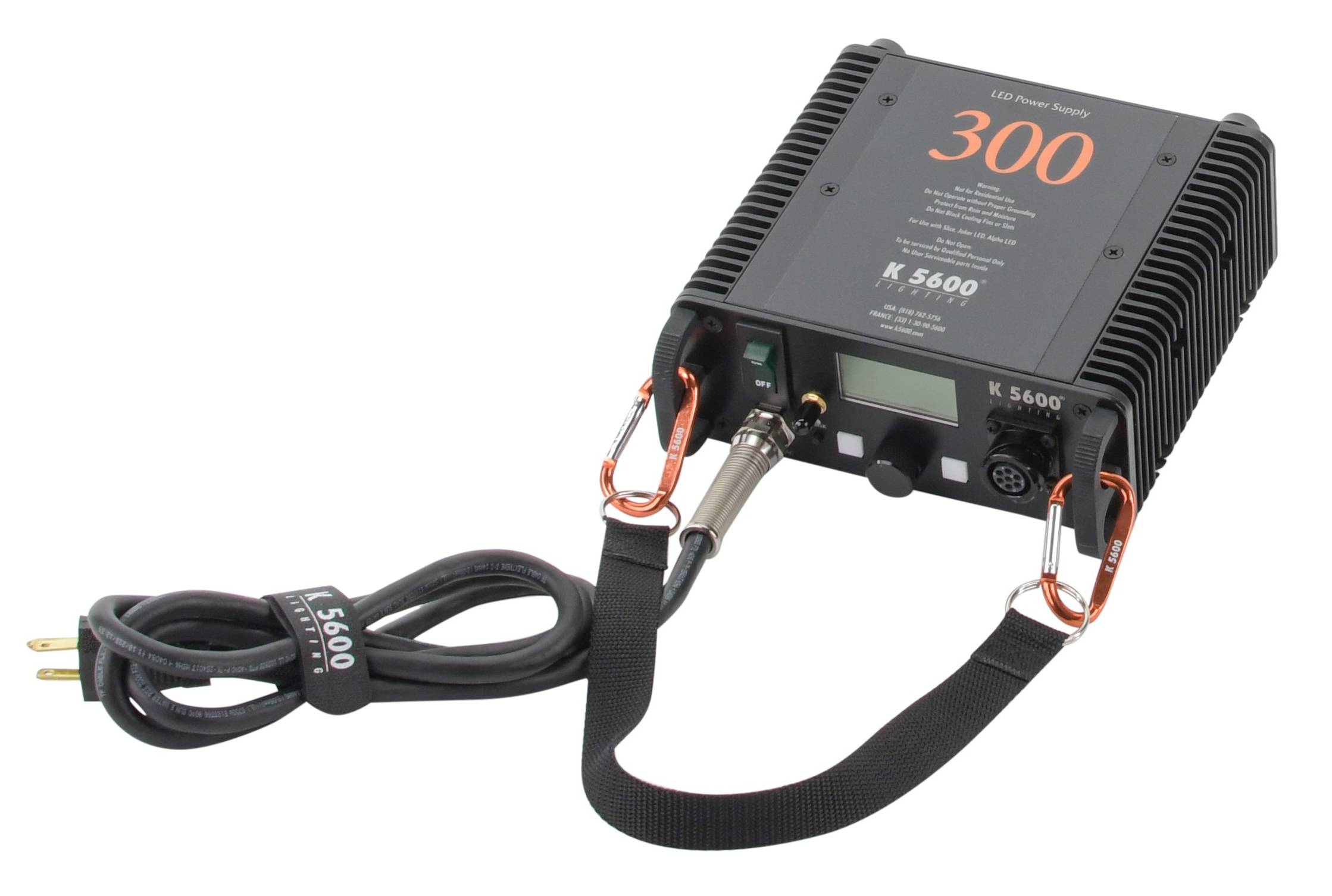
K5600 Lighting has outlets in the US and France; Ryan is based in Los Angeles.
K5600 has been around since the early 90s, and traditionally you have focused on HMIs – primarily through your Joker and Alpha product ranges. How difficult has it been to achieve the same output quality with LED?
K5600 has been an HMI company since its beginning; we’ve designed fixtures around those tried-and-trusted globes that deliver 100 lumen per watt with consistent colour rendering. So, when it comes to LEDs, there’s a high bar to clear – both in output quality and output quantity. Let’s start with the most common misconceptions about LEDs – that their efficiency is tremendous, and they generate no heat.
Output quality. Over the years, LED manufacturing has improved. Careful sourcing has yielded chips with acceptable colour that even play well with other sources. Panels, like our Slice, employ small, linear chips, while an open face, like our Joker 300 (below), needs a powerful, tight cluster of emitters (chip on a board, or COB). Either a panel or an open-face fixture requires careful design to manage heat – if not properly addressed, output quality decreases tremendously and immediately.
Output quantity. How a fixture is designed greatly affects its intensity. LED chips can produce from 30 to 100 lumens per watt or more. Generally, the higher the output, the lower the colour rendering. Once again, heat rears its ugly head. LEDs have a clear heat threshold and cannot operate long term without managing that heat. HMI and tungsten lamps can burn all the way up to 400 degrees Celsius (752°F) while LEDs must remain below 85 degrees Celsius (185°F), and even that is pushing their limits. Overheating immediately decreases output, lifetime and quality.
We’ve addressed the above with two unique designs. With Slice panels, our linear solutions dissipate heat, and with Joker and Alpha, giant heat sinks and the dreaded ‘F’ word (fan).
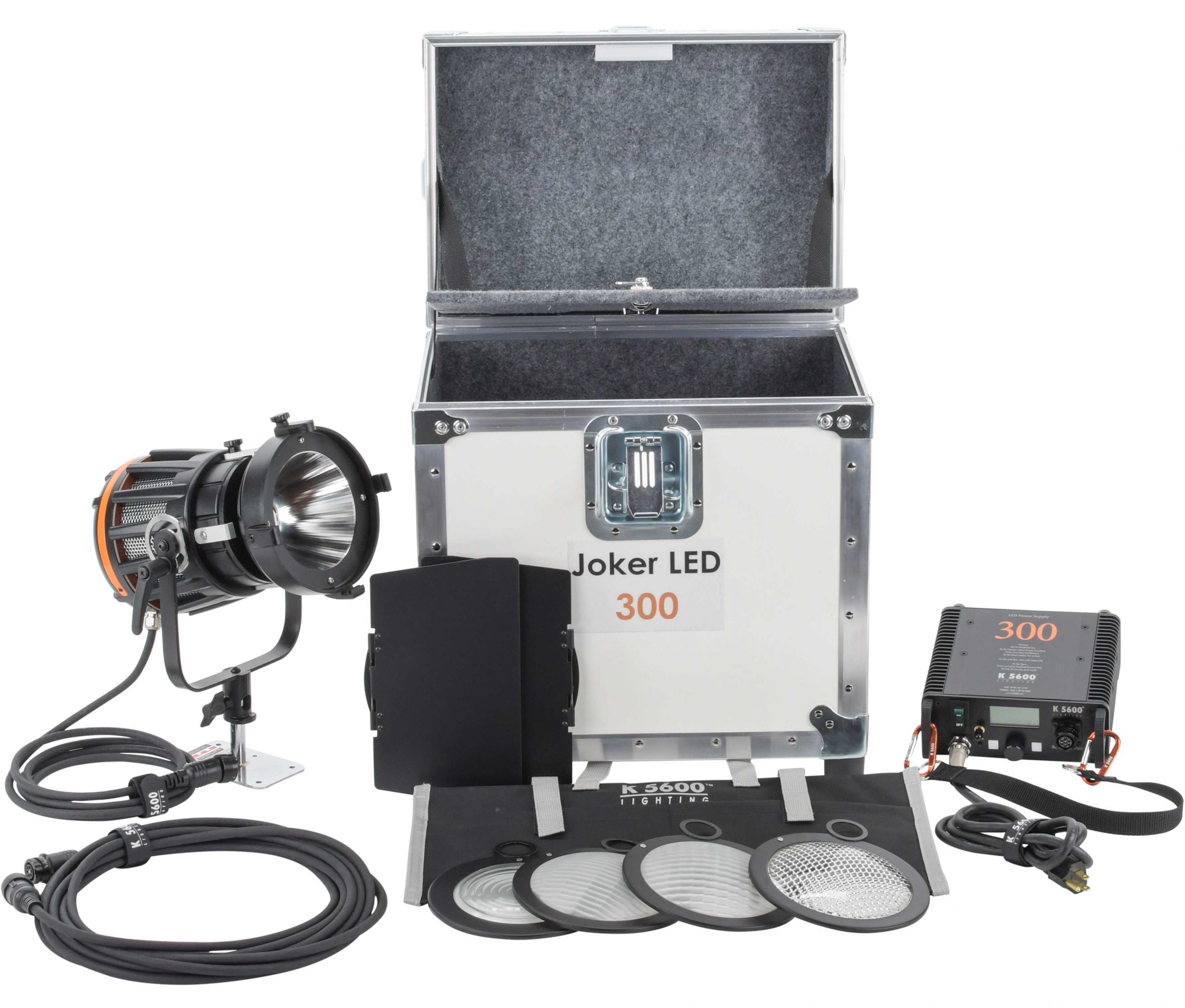
LEDs are everywhere; you waited eight years to launch a full LED eco-system. You didn’t rush in, you sat back and watched. What did you learn? What are the core components of your system, and why did you choose them?
We didn’t simply wait eight years. Every year, every season, almost every day, we researched, tested and prototyped the best available components and designs. We’re glad we kept testing, and the early word from our end-users is they are too.
In designing Joker and Alpha into LEDs, we needed to develop the smallest possible diameter LES (Light Emitting Surface) in order to be able to start with a hard beam of light. Smaller equals sharper. Sharp can easily go soft, but soft can only go even softer.
No LED can be as perfect as a point source (HMI or tungsten lamp), but we’ve compared our COB diameter to all others who are attempting an open-face fixture, and ours is radically smaller.
A small LES is crucial with the Fresnel Lens. To provide controllable and directional light efficiently with soft-edged single shadows, Fresnel lenses each have specific focal lengths and ratios relative to lens size and source size. Placing multiple sources or large sources behind a small Fresnel produces inadequate results, but that’s not to say it isn’t done all of the time.
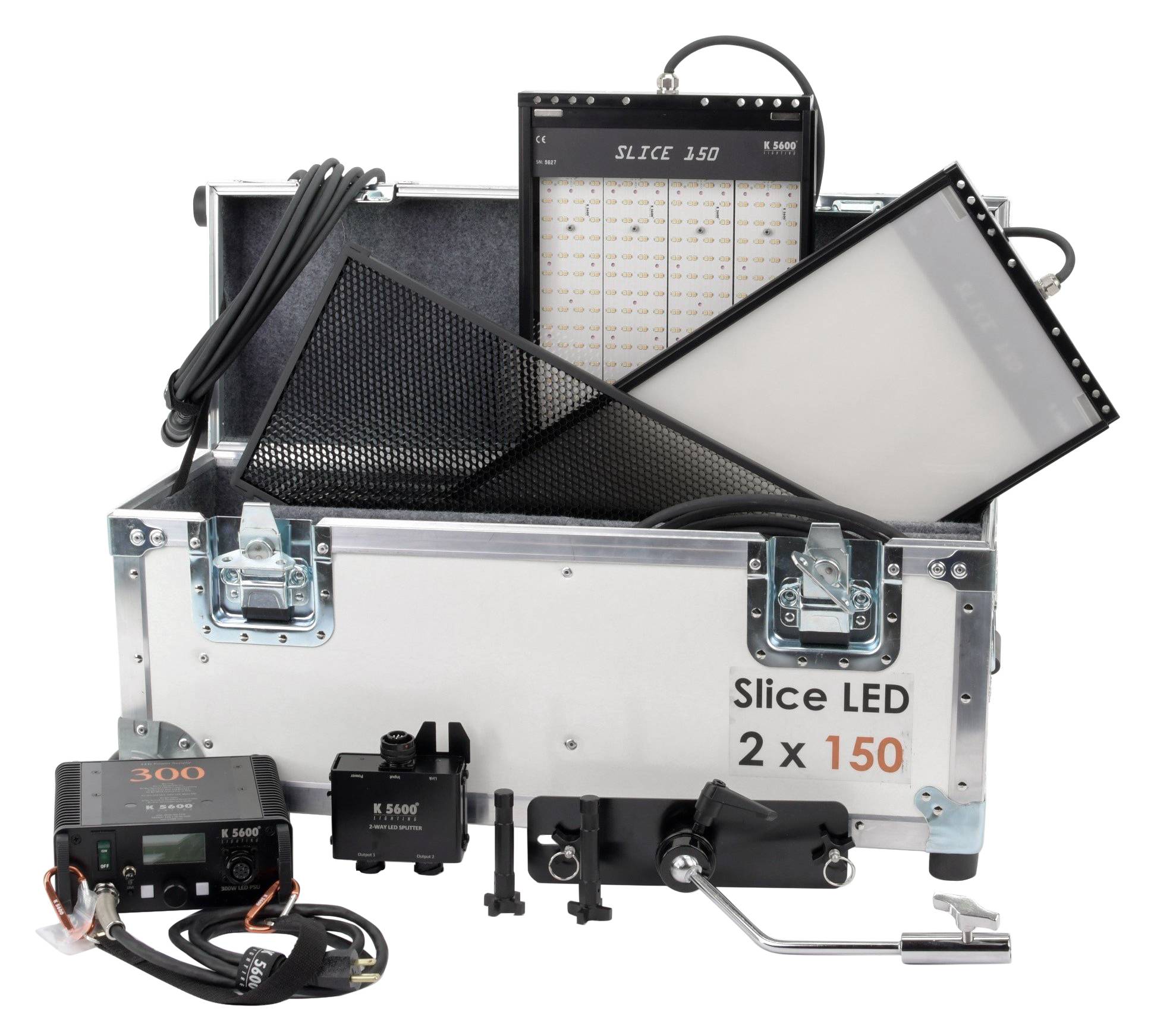 With our Slice panels, we made them thin, rugged, and versatile with gaffers’ problem-solving in mind. Our male/female extrusion design not only acts as a heat sink but offers ways to configure lighting solutions ranging from walls of light to light columns as they slide together in many combinations. Corner holes allow fastening directly to set walls, hanging adapters, simple baby pin attachments and a gooseneck for stand use make it possible to put the light anywhere on set. While there are countless plastic or fabric-based LED panels on the market, we kept hearing that longevity was an issue, and we wanted to solve that with the thinnest, most robust design.
Lastly, our universal power system differs from most other manufacturers. Regardless if you’re using a Joker, Alpha or Slice LED, all are compatible with either our 300W or 1200W power supplies, from the cable to the controls. With the addition of our Splitter Box, you can actually control multiple heads from one power supply, synching their colour temperatures and output, or individually controlling each head. This universal compatibility puts the control in the client’s hands, allowing them to customise a kit for their specific needs. Currently, our 1200W ballast is unique.
Are LEDs destined to replace HMI? Many of your HMI range out-perform your own LED products. Tell us about that.
LEDs have just about done away with the smallest HMIs, and have come closer to medium wattage HMIs, but cannot replace larger lamps. As an example, our Joker 300 LED has a comparable output to our Joker 400 HMI, depending on configuration and accessories. It’s also larger, heavier, and has a fan. But it’s dimmable with variable colour temperature, and you’ll never have to replace a bulb. Being that we have customers who’ve had their Joker HMI for 25 years and are adding more with the recently introduced Joker², I’m not sure which they’ll prefer. But an LED that can overpower the sun and not be the size of a jet engine with forced cooling is only for the distant future.
LEDs are not ready to be the only light on most sets. But when we say ‘most sets’, I think we must further define our client demographics. The content creation boom has everyone from soccer moms to studio features procuring tools to create better content. Medium wattage (800 and 1600) HMIs have become the big lights on many sets, notably those in controlled environments not afraid of higher ISOs.
Additionally, no LED is as flexible from a light shaping perspective as a Joker HMI, though our Joker 300 LED comes close.
We’re fortunate. Our client base is wide, from million-dollar movies to e-commerce studios to YouTube channels, from location news to still photographers to film schools. Saying that LED is destined to replace HMI seems premature… they haven’t even replaced tungsten (although fluorescent might be on its last legs).
With your LED range, you’ve persisted with having an external power supply whereas many manufacturers are choosing to put them inside the head. What drove your thinking on this?
Our philosophy has always been to keep the fixture as compact and streamlined as possible. The smaller and lighter the fixture, the easier it is to get in those hard to reach places. Years ago, some manufacturers tried to put HMI ballasts inside of the heads, and we all saw how that worked out.
We took it one step further and introduced two separate ballasts, a 300W and 1200W. Each is capable of power multiple heads with the help of our custom Splitter Box.
What’s next with your LED range?
Simply put, more colour, and more output. Our clients tend to ask for more output before more colours, because there are enough rainbow tubes on the market to make music videos for eternity. But we continue to listen to the fantasies – ‘Can it be brighter, can it replace an 18K, can the fans go away, can it be smaller than a 1K’. As technology advances, we’ll continue to innovate. It certainly won’t be enough to satisfy those impossible expectations. Still, until someone redefines the laws of physics, we’ll do our best to continue to develop tools that solve problems and get the job done.
Our thanks to Ryan for sharing his experience of LED lighting fixtures. You can find out more about K5600 at www.K5600.com and Power Gems LED drivers and systems here
This interview is part of an occasional series. If you enjoyed this, you should read:
HMI Lighting: Power Gems interviews Marc Galerne of K5600
‘I am like Benjamin Button’: Power Gems interviews Michel Trudel of Mels Studios
Cables, cord-cutting and Canada: Power Gems interviews Garin Josey of William F White International
From Stills to Film and TV: Power Gems interviews Toby Newman of Pixipixel
Sun, Spain and HMI fixtures: Power Gems interviews Alfons Grau Pitarch of Grau Luminotecnia
Who is Gillian Holt? Get me Gillian Holt for this film!
Stefan and Benjamin Schmidt of STS talk about the theatrical lighting scene in Germany
Xenon lighting: Power Gems interviews Greg Smith of Arc Light EFX
